
Beyond Bitcoin: ZEC, CKB, ETC and HNS in a Multi-Coin Pool
Bitcoin's 3.125 BTC block subsidy, paid across roughly 144 blocks a day, puts 450 BTC — about $38.1 million at a $84,692 price — in front of the whole network every 24 hours. A single-coin miner competes for that entire pool of emission with one type of hardware. A multi-coin pool lets the same machine switch between more than twenty chains, and the decision to do so rests on two variables that never appear in marketing material: the listed fee per payout component, and how much of the day your hardware is actually hashing.

Key takeaways
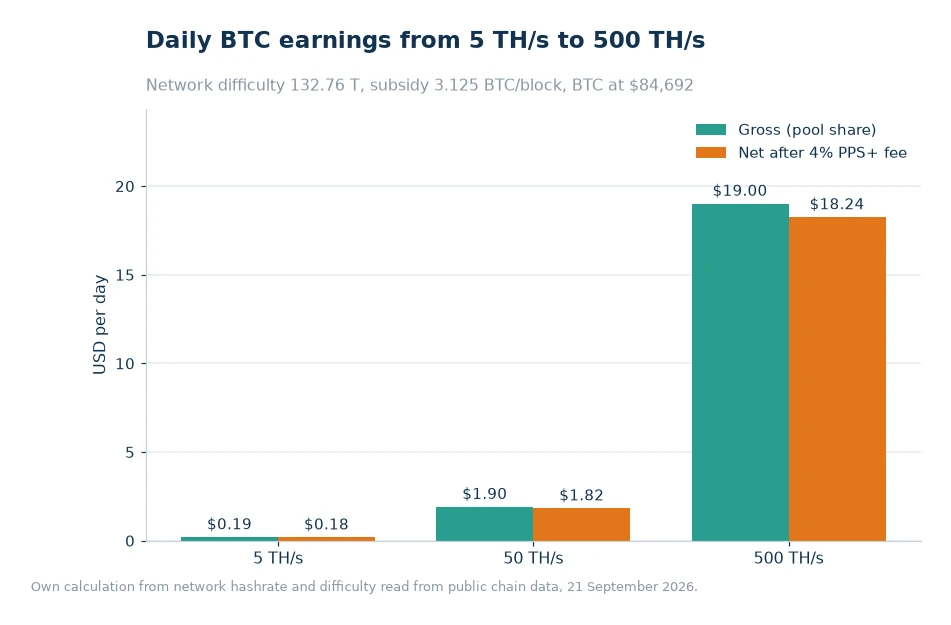
- A 500 TH/s rig produces about 0.000224 BTC a day — $19.00 at $84,692 — and netting the listed 4% PPS+ fee on the block-reward component leaves roughly $18.24.
- Merged mining lets one Scrypt machine secure LTC and DOGE together, so the same electricity bill can settle two chains instead of one.
- The pool supports more than 20 coins, including BTC, BCH, LTC/DOGE, KAS, ZEC, HNS, CKB and ETC, which means switching chains rarely requires moving hardware.
- Every extra chain adds its own difficulty and price, so the formula stays the same while the inputs change daily — recalculate before each switch, not after.
Context in 2026
Network conditions on 21 September 2026 were unremarkable in the way that matters: BTC difficulty stood at 132.76 T, network hashrate near 1,003 EH/s, and the next adjustment was estimated at about -2.12%. A mid-single-digit retarget either way is noise for a farm that plans capital over years. What is not noise is the number of chains a miner can point hardware at without buying anything new.
Why miners diversify across chains
Every chain pays for its own security, and each one prices that security differently depending on how much hashrate has already arrived. A chain with modest competition can hand a machine a larger share of its emission than Bitcoin can at the same power draw. The catch is that a share of a smaller emission is not automatically worth more in dollars — which is why the comparison has to be done per chain with real numbers rather than with sentiment.
The two variables that matter
The first variable is unit economics: for any chain, your daily output equals your hashrate divided by that chain's network hashrate, multiplied by that chain's daily emission. For BTC today the whole network emits 450 BTC, so each TH/s is worth about 4.486 × 10⁻⁷ BTC a day, or $0.038 at $84,692. The same structure applies to ZEC, CKB, ETC, HNS and the rest — only the emission, the network hashrate and the price change.
The second variable is time on target. A rig that spends three hours a week being reconfigured, rebooting or waiting on a firmware change earns nothing for those hours regardless of which chain it is pointed at. Multi-coin support only pays if switching costs you minutes rather than afternoons.
| Chain | What it adds | Verify before switching |
|---|---|---|
| BTC | Deepest liquidity and a 3.125 BTC block subsidy; 450 BTC emitted network-wide per day | Listed fee per payout component; PPS+ hourly settlement versus PPLNS timing |
| BCH | A second SHA-256 chain that existing hardware can be redirected to | That chain's difficulty and price on the day of the switch |
| LTC / DOGE | Merged mining: one Scrypt machine contributes to both chains at once | Whether output from both chains is credited to the same account |
| KAS, ZEC, HNS, CKB, ETC | Additional chains inside the same 20+ coin roster, each with its own reward schedule | Firmware support for the coin, and current profitability at your power price |
Fees do not transfer between methods
The most common accounting error in multi-coin mining is assuming one fee rate covers everything. PPS+ applies a listed 4% fee to the PPS-settled block reward and a listed 2% fee to the transaction-fee component, because the pool absorbs pool-luck and orphan risk on the first part.[1] PPLNS merges both components into one distribution at a listed 2% fee and leaves the timing risk with the miner. On a chain where transaction fees are a large share of the reward, that difference is worth more than it is on Bitcoin.
Numbers from a real rig
Take a 500 TH/s rig built from 20 J/TH machines. At current Bitcoin difficulty it produces 500 × 4.486 × 10-7 BTC, which is 0.000224 BTC a day — $19.00 gross, or $18.24 after the listed 4% fee on the block-reward component. Power is the other half of the calculation: 500 TH/s at 20 J/TH draws 10 kW, or 240 kWh a day, which costs $14.40 at $0.06/kWh. That leaves $4.60 a day of margin on Bitcoin before anything else, and about $138 a month.
Point the same rig at a chain where competition is thinner and the share of that chain's emission grows, and the gross figure can rise without changing the power bill — but the price of that chain's coin then sets the dollar outcome, and prices move faster than difficulty. That is the whole argument for keeping several chains a firmware edit away rather than committing hardware to one.
Working across chains turns monitoring into a portfolio problem, and the cleanest way to keep it honest is to keep every chain in one view. The mining pool dashboard reports hashrate and settlement for supported chains side by side, and a profit calculator handles merged-mining output as well as single-chain estimates, so the comparison uses the same inputs on both sides of the decision.
Established operators reach the same conclusion from the other direction: a pool that already runs many chains lets a miner add ViaBTC Bitcoin Mining and its 20+ coin roster under one account, with payout history, wallet balances and auto conversion in the same place instead of spread across separate logins.
Decision guide
- Fix your power cost first. At $0.06/kWh, a 20 J/TH machine needs to clear $0.0288 per TH/s per day; below that line, no chain choice saves the rig.
- Compute per chain, per day. Use that chain's network hashrate, emission and price — never reuse Bitcoin's numbers for an altcoin.
- Prefer chains your firmware already supports so switching is a configuration change, and keep the downtime under an hour.
- Check what merged mining adds. On LTC/DOGE the same Scrypt work can settle two chains, which changes the break-even calculation.
- Recheck monthly. Difficulty retargets and price moves reorder the ranking; a chain that led last quarter may not lead now.
Frequently asked questions
Do mining pools cost anything to join?
Joining is free; the pool earns from its fee on settled payouts, which appears as a percentage of the block-reward and transaction-fee components.
Can I mine more than one coin at the same time?
Yes. Merged mining lets a machine secure a parent chain and an auxiliary chain together, and multi-coin pools support switching between chains without moving hardware.
Which coins can a multi-coin pool actually run?
More than twenty, including BTC, BCH, LTC/DOGE, KAS, ZEC, HNS, CKB and ETC, with published guides for BTC, BCH, LTC and KAS to get the configuration right.
Does switching chains change how I am paid?
The payment method governs settlement, not the coin: PPS+ settles hourly against current difficulty, while PPLNS distributes after a block receives six confirmations, weighted over the last five difficulty rounds.
Build the roster before you need it
Add at least two alternative chains to your configuration now, while nothing is urgent, so a difficulty spike or a price move becomes a fifteen-minute change rather than a procurement project. Write down each chain's network hashrate, emission and price for the day you switch, and reconcile the first payout against your own arithmetic. The miners who handle multi-coin operations well are not the ones with the most machines; they are the ones who already know what the next chain would pay.
Data and sources: ViaBTC pricing page for the listed PPS+ and PPLNS fee split[1] and the ViaBTC mining statistics page for pool and network hashrate[2]. Network difficulty (132.76 T), network hashrate (about 1,003 EH/s), the 3.125 BTC block subsidy, the estimated -2.12% next adjustment, and BTC, LTC, BCH and KAS prices were read from public chain data and market feeds on 21 September 2026. Figures are illustrative and change with difficulty and price.